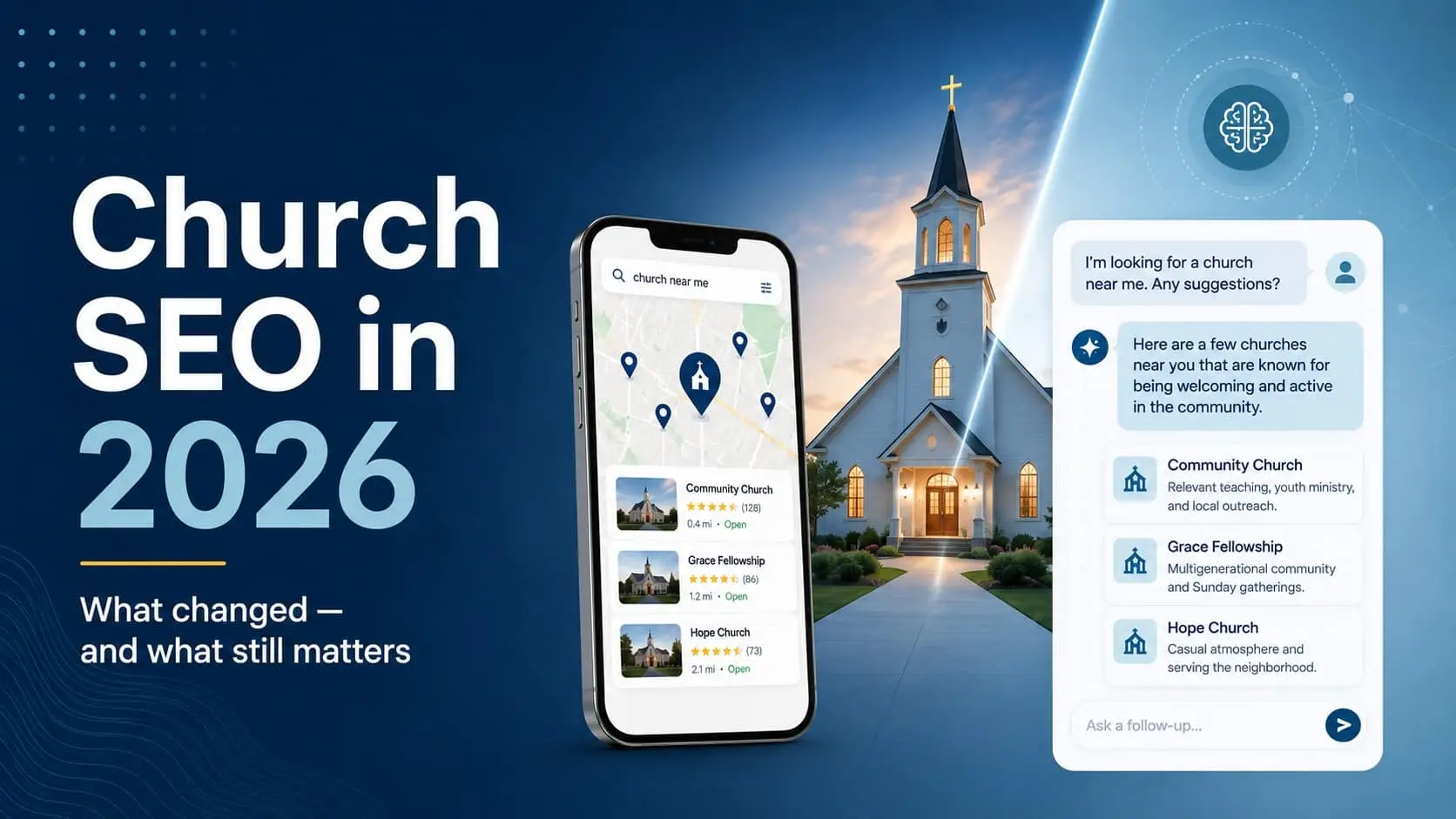
Two people go looking for a church this Sunday.
The first one, a woman who moved to town in April, opens her phone and types “churches near me.” She gets a map with three listings. She taps one, checks the service time, and decides whether her family can make the 10:45.
The second one, a guy who hasn’t been to church since college, doesn’t search anything. He opens ChatGPT and types: “I want to start going to church again but I don’t know where to begin. What should I look for and are there any good ones near me?” He gets a conversational answer with two or three church names in it.
Here’s the thing pastors need to understand about 2026: those two people just used completely different systems, and your church has to be built for both. The first system barely changed this year. The second one didn’t exist in any meaningful way three years ago.
Most of what’s written about church SEO was written for the first person. So let’s talk about what the work actually looks like now.
Key Takeaways
- Church SEO has split into two jobs. Ranking in the map pack when someone searches “church near me,” and getting cited when someone asks an AI a question about churches. They need different work.
- Simple local searches barely changed. For queries like “Baptist church [your city],” the map pack still dominates and your Google Business Profile is still the single biggest lever.
- Question-shaped searches changed enormously. Industry research puts AI Overviews on more than 90% of informational local queries, and those are exactly the questions church seekers ask.
- Clicks are down across the board. Pew Research found users click a search result 8% of the time when an AI summary appears, versus 15% when it doesn’t.
- For AI visibility, your website matters more than your profile, the reverse of the map pack. That’s the biggest strategic shift of the year.
- The fundamentals didn’t get replaced. Complete profile, clear website, accurate information, real reviews. AI made those things matter more, not less.
- Stop asking for reviews. Ask people to share their experience instead, you’ll get more of them, and they’ll be the kind that actually help a stranger decide.
- Be skeptical of anyone selling “AI search optimization” as a product. The measurement tools are immature and the honest answer is that a lot of this is still being figured out.
What Is Church SEO in 2026?
Church SEO is the practice of structuring your church’s website, Google Business Profile, and online information so that search engines, and now AI systems, can accurately understand who you are, where you are, and who you serve, then show your church to people in your community who are looking for one.
That definition would have been about half as long two years ago. The addition is the part in the middle, and it’s not cosmetic.
Until recently, church SEO meant competing for position on a page of blue links and a map. The work was: claim your profile, fill it in completely, make your website clear and fast, get some reviews. That still works. But it’s now only part of the job, because a growing share of people never reach the page of links at all.
Think of it as three surfaces instead of two:
The map results. Someone searches “church near me” and Google shows a map with a handful of listings pulled from Google Business Profiles. This is still where most local church discovery happens, and it’s still the highest-leverage thing most churches can fix.
The AI answer. Someone asks a question, in Google’s AI Overview, in AI Mode, or in ChatGPT, Gemini, or Perplexity, and gets a written answer that may or may not mention your church by name. There’s no ranking here. You’re either in the answer or you’re not.
Your website. Which now does double duty: it converts the humans who click through, and it’s the raw material AI systems read to decide whether your church is worth mentioning at all.
I’ll say the thing I say to every pastor who asks about this: SEO is signage. Nobody builds a sanctuary off a busy road and then refuses to put up a sign because signs feel like marketing. What’s changed is that there’s now a second kind of sign, in a second kind of place, and most churches haven’t noticed it went up.
What Actually Changed This Year
I want to give you real numbers here, because there’s a lot of hand-waving in this space and the honest picture is more interesting than the panic.
Clicks are down, meaningfully
Pew Research Center tracked the actual browsing behavior of 900 U.S. adults and found that when an AI summary appeared on a results page, people clicked a traditional search result 8% of the time. When no AI summary appeared, they clicked 15% of the time, nearly twice as often. Clicks on the sources cited inside the AI summary itself? About 1%.
Follow-up research through 2026 has pointed the same direction. SparkToro’s analysis of U.S. search behavior in early 2026 found that fewer than one in three Google searches now sends a click to any website at all.
But local search is a different animal
Here’s the nuance almost everybody misses, and it matters enormously for churches.
Whitespark’s 2026 local search research found AI Overviews appearing on roughly 68% of local queries overall, but that number hides a split. For simple local intent searches, the kind where somebody just wants a place and a time, the map pack still shows up more than 90% of the time and AI Overviews appear on only about 15% of them.
Translated to your world: “churches near me” and “Presbyterian church in [your city]” are still map-pack searches. Google understands that when someone wants a nearby place, they want an address and hours, not an essay. Your Google Business Profile is still the thing that wins those.
That’s the good news, and it’s genuinely good news. The core discovery query for churches is among the least disrupted searches on the internet.
The disruption is in the questions
The same research found AI Overviews appearing on more than 90% of informational local queries and around 97% of hybrid-intent queries, the ones that mix a question with a location.
And there’s a second front. Consumer research in 2026 found that roughly 45% of people now use ChatGPT or a similar AI tool to get local recommendations, up from about 6% a year earlier. That’s not a gentle trend line. That’s a behavior change inside twelve months.
The searches where churches are most exposed
Put those two findings together and you get the specific shape of the church problem.
People looking for a church don’t just search for churches. They ask questions first, often for weeks before they ever search a location. Look at the kind of thing a real person types or says:
- “What should I wear to church?”
- “How do I find a church that’s right for my family?”
- “What’s the difference between non-denominational and Baptist?”
- “Is it weird to go to church alone?”
- “What actually happens at a church service?”
- “Best churches for young families in [city]”
- “Churches with good kids programs near me”
Every single one of those is informational or hybrid intent. Which means every single one of them now lands, overwhelmingly, in AI-answer territory rather than map-pack territory.
So here’s the uncomfortable summary: churches are relatively protected on the query that names them and heavily exposed on every query that leads up to it. The entire pre-decision research phase, the part where somebody works up the nerve, has moved into a system most churches have never thought about.
And when a church shows up in one of those answers, it usually shows up because an AI system found clear, plainly written content that actually addressed the question. Which brings us to what you can do about it. We wrote about the moment someone finally lands on your site in The Digital Front Door; this is the stretch of road that comes before it.
What Google Still Measures
Before the new stuff, the foundation, because it hasn’t been replaced, and you can’t skip it.
Google’s own Business Profile documentation says local results are determined primarily by three factors: relevance, distance, and prominence.
Relevance
How well your information matches what someone typed. Categories, service listings, description, and the actual words on your website. Most churches lose here through vagueness, a profile that says “Church” and nothing else gives Google nothing to match against.
Distance
How far you are from the searcher. You can’t change this. But it’s relative to the field: if the three churches closest to somebody all have unclaimed or inaccurate profiles, a church a bit farther out with a complete one can and does outrank them.
Prominence
How well known and well regarded your church appears, reviews, links from other sites, consistent mentions of your name, address, and phone number across the web.
Prominence is the one that’s quietly gotten more important, because it’s also the strongest signal AI systems use. An AI model deciding whether to name your church in an answer is essentially asking: does this place seem real, active, and well regarded? That’s prominence, wearing a different hat.
The New Layer: Getting Cited by AI
For the first time, Whitespark’s annual survey of local search experts added a category for AI search visibility, how businesses end up named inside AI Overviews, AI Mode, and assistant answers. The findings are worth sitting with.
For the traditional map pack, Google Business Profile signals carry the heaviest weight of anything controllable, at roughly 32%, with reviews next at around 20% and on-page website factors trailing.
For AI search visibility, that formula inverts. On-page website content moves to the top spot at roughly 24%, while Business Profile signals drop to around 12%.
That single reversal is the most important strategic fact in church SEO right now, and here’s what it means in practice.
Your Google Business Profile is a set of structured facts: name, address, hours, category. An AI system answering “what should I know before visiting a church in Norfolk” can’t do much with that. What it can use is a page on your website that plainly explains what your services are like, what to wear, what happens with kids, how long it runs, and what someone should expect walking in alone.
In other words: the content you’d write to be genuinely helpful to a nervous first-time visitor is the same content that gets your church named in AI answers. That’s an unusually happy alignment, and it’s the reason I’m not cynical about this shift. The incentive points toward being clearer and more hospitable, not toward gaming anything.
The churches that will do well here are not the ones with the biggest budgets. They’re the ones willing to write down, in plain English, the answers they already give people in the lobby every week.
Six Building Blocks of Church SEO in 2026
1. A complete, claimed Google Business Profile
Still the highest-leverage item on this list, still free. Claim it, verify it, then fill in everything: primary and secondary categories, service times as recurring hours, a real description, phone number, and current photos of actual people in your actual building.
Two things I check first on every audit: whether the hours reflect current service times, and whether any photo is from this year. A profile with fifteen photos from 2019 reads as a church that may not still be meeting.
2. Plain-language answers to the questions people actually ask
This is the new work, and it’s where most churches have nothing. Build real pages, not a buried FAQ accordion, that answer the questions in the list above. What to expect. What to wear. What happens with kids. What you believe, stated plainly enough that someone with no church background understands it.
Write them the way you’d talk to someone in the parking lot. AI systems and nervous visitors both reward clarity over polish, and both get lost in insider language.
3. Structured data on your site
Schema markup is code that tells search engines and AI systems what your pages mean rather than making them guess. For churches, the useful types are Church or Organization for your identity, Event for services and programs, and FAQPage for question content.
This is the least glamorous item here and one of the most reliably useful, because it removes ambiguity, and ambiguity is exactly what causes an AI system to skip you.
4. Location clarity throughout
Your city and region should appear naturally in page titles, headings, and body copy. “Grace Community Church in Chesapeake, Virginia” tells a machine something that “Grace Community Church” alone does not.
Multiple campuses need separate pages with separate addresses, separate service times, and separate profiles. One combined page dilutes all of them.
5. Reviews, links, and consistent information everywhere
Get listed accurately in local directories, denominational listings, and community pages. Make sure your name, address, and phone number are identical in all of them. Inconsistency here is common and genuinely damaging, if three directories list three different phone numbers, confidence in all three drops, for Google and for the AI systems reading the same sources.
Reviews belong in this bucket too, and they’re the piece most churches handle badly. That deserves its own section, so it gets one below.
6. Speed and mobile experience
Most of this happens on phones, often on cellular data, usually in a hurry. A site that takes six seconds to load has already lost a share of the people who clicked. The usual culprits are uncompressed hero images, video backgrounds, and page builder bloat.
How to Ask for Reviews Without Ever Mentioning Reviews
This is the part of our process I get asked about most, and I’d hand it to a church even if they never worked with us.
Every church leader I’ve met knows reviews matter, and almost none of them want to ask. “Leave us a Google review” sounds like something a plumber says. It feels transactional in a place that isn’t supposed to be transactional, and the second a pastor says it from the stage, the whole room hears the marketing in it. So the ask never happens, and the church sits at nine reviews from 2021.
We solved that by removing the word.
Ask people to share their experience
We don’t ask anyone for a review. We ask people to share their experience, and we hand them a link that happens to open the review box. Nobody has to hear the word “Google” at any point. The ask sounds like this:
“Would you take two minutes to share your experience of our church?”
And then the line that does the actual work:
“What you write could be exactly what someone needs to read to find the confidence to walk through our doors.”
That second sentence changes the nature of the request entirely. You’re not asking a member to do the church a favor or help its ranking. You’re inviting them into ministry, asking them to speak to a stranger who is nervous, probably alone, and scrolling at eleven at night wondering whether they’d be welcome.
People say yes to that. They say yes far more often than they say yes to a request that sounds like marketing, and they don’t need to be chased.
Why this produces better reviews, not just more of them
Here’s the part that surprised me the first time we tracked it: the framing changes what people write.
“Leave us a review” produces “Great church!”, four syllables that help nobody. “Share your experience so someone else can find the confidence to come” produces paragraphs. It produces someone writing that they showed up with a three-year-old and a newborn and check-in took under five minutes. It produces someone saying they hadn’t been to church in eleven years and nobody made it weird.
Those are answers to questions strangers are already asking. And they’re specific, which means they name your city, your ministries, and the actual experience of attending, exactly the raw material that feeds relevance for Google and gives an AI system something quotable when someone asks about churches in your area.
Which brings this back around to the whole point of the article: the thing that helps a nervous visitor and the thing that makes your church findable keep turning out to be the same thing.
When to send the link
Google generates a short share link from inside your Business Profile. Use that one, it opens the review box directly instead of dropping people onto a profile they have to figure out. Then send it at one of two moments, both of them after the person has left the building.
The follow-up after someone visits. This is the primary one. Whatever email or text you already send a first-time guest on Monday or Tuesday, the link goes there. The experience is still fresh, they’ve already had one warm interaction with you, and you’re not interrupting anything.
When someone signs up for a next steps class. This is the trigger most churches would never think of, and it’s the better of the two. Somebody registering for next steps has just decided your church is worth more of their life. They’re at the peak of their enthusiasm and they have an actual story, they can tell you why they came back. That’s the person whose words will move a stranger.
A few secondary moments worth using once the main two are running: volunteer thank-you notes, a standing invitation in your newsletter footer, and after a baptism, wedding, or milestone, when people are already putting words to what your church means to them.
One practical note: send by text where you have the number. Review links sent by SMS get opened and acted on at a much higher rate than the same link buried in an email, and the ask is short enough that it doesn’t feel like an imposition in a text.
Three lines you shouldn’t cross
Google tightened its review rules in early 2026 and enforcement got noticeably sharper, so it’s worth knowing where the edges are. Per Google’s prohibited and restricted content policy:
- Ask everyone, not just the people you expect to be kind. Filtering by sentiment, sending happy people to Google and unhappy people to a private form, is called review gating, it’s prohibited, and it’s actively enforced.
- Never attach an incentive. No gift cards, no drawing entries, no “share your experience and grab a coffee on us.” Google bans incentives regardless of what the review ends up saying.
- Don’t ask inside the building. The current policy specifically prohibits pressuring people to leave reviews while on the premises, and review kiosks and shared tablets are explicitly out. If your church added a lobby QR code or an iPad at the welcome desk in the last year or two, that’s now a liability worth removing. Sending the link afterward, by email or text, sidesteps the problem entirely, which is one more reason we do it that way.
One more, and it’s the one that trips up well-meaning churches: don’t tell people what to write. Asking someone to mention a specific ministry or a staff member by name is against policy now. Ask for their experience and let it actually be theirs, which, conveniently, is also what makes it worth reading.
What Hasn’t Changed (and What to Be Skeptical Of)
Let me be direct about the boundaries, because there’s more noise in this space every month.
What hasn’t changed
It’s still not tricks. Hidden text, keyword stuffing, spun content, all of it worked poorly before and works worse now. AI systems are, if anything, better at ignoring padding than the old algorithms were.
It’s still not a growth strategy. SEO gets more of the right people to your door. It cannot make them stay. Better visibility just means more people experience whatever your Sunday actually is.
It’s still not social media. Social reaches people who already know you exist. Search and AI reach people who don’t. A church can have a busy Instagram and be completely invisible to a searcher, that combination is extremely common.
It’s still not a one-time project. Service times change, staff turn over, and the systems keep moving. A site optimized in 2023 and untouched since has drifted further than you’d guess.
And it’s still not manipulation. We’re not persuading anyone to want a church. We’re removing friction for people who already do. AI didn’t change that, and I’d walk away from this work if it did.
What I’d be skeptical of
Since roughly last fall, a category of vendors has appeared selling “GEO,” “AEO,” or “AI search optimization” to churches and nonprofits. Some of it is real work with a new label. A lot of it isn’t. Three things I’d push back on:
“We’ll get your church into ChatGPT.” Nobody can guarantee this. There’s no submission process, no index you can buy into, and no ranking to purchase. What actually works is being clear, well documented, consistently described, and frequently mentioned, which is just good SEO with the volume turned up.
Confident measurement claims. AI citation tracking is early. The tools sample prompts and report how often you appear, which is directionally useful and nowhere near the precision of rank tracking. Anyone showing you a clean AI visibility score without heavy caveats is overselling.
“SEO is dead.” It isn’t, and the local data above is the clearest evidence. The core church discovery query is still a map-pack query. What died is the assumption that ranking equals traffic.
My honest position: this is a real shift that deserves real attention, and it is also being aggressively oversold. Both things are true.
Church SEO vs. Google Ads and Ad Grants
SEO earns visibility over time and doesn’t stop when you stop paying. Google Ads buys visibility immediately and stops the day you turn it off. Most churches benefit from both, ads to cover the gap while SEO develops, then ads focused on Christmas, Easter, and launches once organic visibility is established.
If you’re a registered 501(c)(3), the Google Ad Grants program provides eligible nonprofits up to $10,000 per month in in-kind search advertising. Real opportunity, genuinely underused by churches.
Two honest caveats. Eligibility requires a website Google considers high quality, so the groundwork usually has to come first anyway. And grant accounts have ongoing compliance requirements and go dormant without active management, a large share sit almost entirely unspent. Valuable, but not free money that manages itself.
You can see how we handle both on our services page, and what engagements cost on our pricing page.
Where to Start This Week
Each of these is a check you can run right now and the fix that follows from it. Do the whole thing on your phone, it takes about fifteen minutes and it’s more revealing than any report I could hand you.
1. Search “churches near me” on a phone that isn’t on your church’s WiFi. Are you in the map results? If not, your Google Business Profile is the problem, and it’s the highest-leverage free fix available. Claim it, verify it, and fill in every field, primary and secondary categories, service times entered as recurring hours, a real description, phone number.
2. Look at that profile the way a stranger would. Are the service times right? Is any photo from this year? A profile with fifteen photos from 2019 reads as a church that may not still be meeting. Fix the hours everywhere they appear, profile, website, socials, denominational directories, and add ten current photos: the building from the road, the parking lot, the entrance, the kids’ area, and real people in real services.
3. Ask ChatGPT or Gemini: “What are some good churches in [your city] for a family with young kids?” Are you mentioned? Is what it says about you accurate? This is usually the most sobering ten seconds of the exercise, and the fix is the next item.
4. Search “what should I wear to church” and read the AI answer. Notice that your church could have written that, and didn’t. So write it: one honest “What to Expect” page covering service length, what people wear, where to park, what happens with children, and what you believe in plain words. This single page does more for your AI visibility than anything else on this list.
5. Hand your phone to someone who’s never attended and ask them to find your service time and address. Watch where they hesitate. Don’t help. Whatever made them pause is your first website fix. This one is still the most uncomfortable and the most useful, you know your own site too well to see it clearly anymore.
6. Ask fifteen people to share their experience. Not a review request and not a campaign, a specific ask to specific people, sent afterward, with the link and the line about helping someone else find the confidence to walk in.
None of that requires an agency. If you’d rather work through it with someone, that’s what we’re for, but I’d rather you do it yourself than not do it at all.
How long before any of this shows up
- Google Business Profile fixes: days to a few weeks. Still the fastest win available. A thorough cleanup can change map visibility inside two weeks.
- Technical website fixes: two to six weeks. Speed, mobile issues, page titles, schema. Quick to implement and they compound.
- Question content and AI visibility: three to six months. Content has to be published, crawled, and then repeatedly encountered before it starts showing up in answers.
- Competitive market rankings: six to twelve months. Dense metro areas with established churches take longer.
Reasonable expectation: meaningful improvement in one to three months, substantial change in six. Anyone promising page one in thirty days is counting on you not checking.
Frequently Asked Questions
What is church SEO in 2026?
Church SEO is the work of making your church’s website, Google Business Profile, and online information clear and complete enough that search engines and AI systems can confidently recommend your church to people nearby who are looking for one. In 2026 it covers two distinct jobs: ranking in Google’s map results for searches like “church near me,” and being cited by name when someone asks an AI assistant a question about finding a church.
Has AI made church SEO obsolete?
No, but it changed the shape of the work. Simple local searches like “churches near me” still return the traditional map pack more than 90% of the time, so Google Business Profile optimization remains the highest-impact activity. What changed is that question-shaped searches now overwhelmingly return AI-generated answers, and those questions are where most church seekers begin.
How do I get my church mentioned in ChatGPT or Google’s AI answers?
There’s no submission process and nobody can guarantee it. What works is publishing clear, plainly written content that directly answers the questions people ask, adding structured data so systems can interpret your pages accurately, keeping your name, address, and phone number consistent everywhere online, and building genuine reviews and local mentions. Industry research indicates website content carries roughly twice the weight of Google Business Profile signals for AI visibility, the reverse of the map pack.
Can a small church compete with a large church in search results?
Often, yes. Local search weighs distance heavily, so a small church can outrank a megachurch across town for searchers in its own neighborhood. AI visibility depends more on clarity and consistency than on size, which means a small church with genuinely helpful content can be cited ahead of a large church with a vague website.
How do we ask for Google reviews without it feeling awkward?
Don’t ask for reviews. Ask people to share their experience, and give them a link that opens the review box directly. Pair it with a reason that isn’t about the church: what they write could be exactly what someone needs to read to find the confidence to walk through the doors. That framing gets more responses and produces specific, story-shaped reviews instead of “Great church!” Just make sure you ask everyone rather than only the people you expect to be positive, never attach an incentive, and send the link afterward rather than asking people inside the building, Google’s 2026 policy prohibits all three.
How much does church SEO cost?
The highest-impact items, claiming your profile, correcting your information, adding photos, writing a real “What to Expect” page, asking for reviews, cost nothing but staff time. Ongoing professional work varies with your market and starting point; our pricing page lays out how we structure it.
How do I know if any of this is working?
Track four things: your position in map results for “church near me” from several points around your area, the direction requests and calls your Business Profile generates, whether AI assistants mention your church when asked about churches in your city, and how many first-time guests say they found you online. That last one requires actually asking, and it’s still the number that matters most.
Get Your Free Church Online Visibility Audit
If you’ve read this far, you probably suspect your church isn’t showing up the way it should. That suspicion is usually correct, and it’s usually fixable faster than people expect.
We’ll show you exactly where your church currently appears in local search, what your Google Business Profile is missing, how your site performs for a first-time visitor on a phone, what AI assistants currently say about your church when someone asks, and the three highest-impact changes to make first. No obligation, no pitch deck.
Request your free Church Online Visibility Audit, or get in touch if you’d rather talk it through first.
At ChurchFound, this is the only thing we do. We work exclusively with churches and ministries, because the goal was never traffic, it’s the woman with four minutes on a Sunday morning, and the guy typing a nervous question into a chat box at midnight, both finding a church where they can belong. Learn more about why we started, browse the rest of our blog, or see how we help churches connect with the people already looking for them.